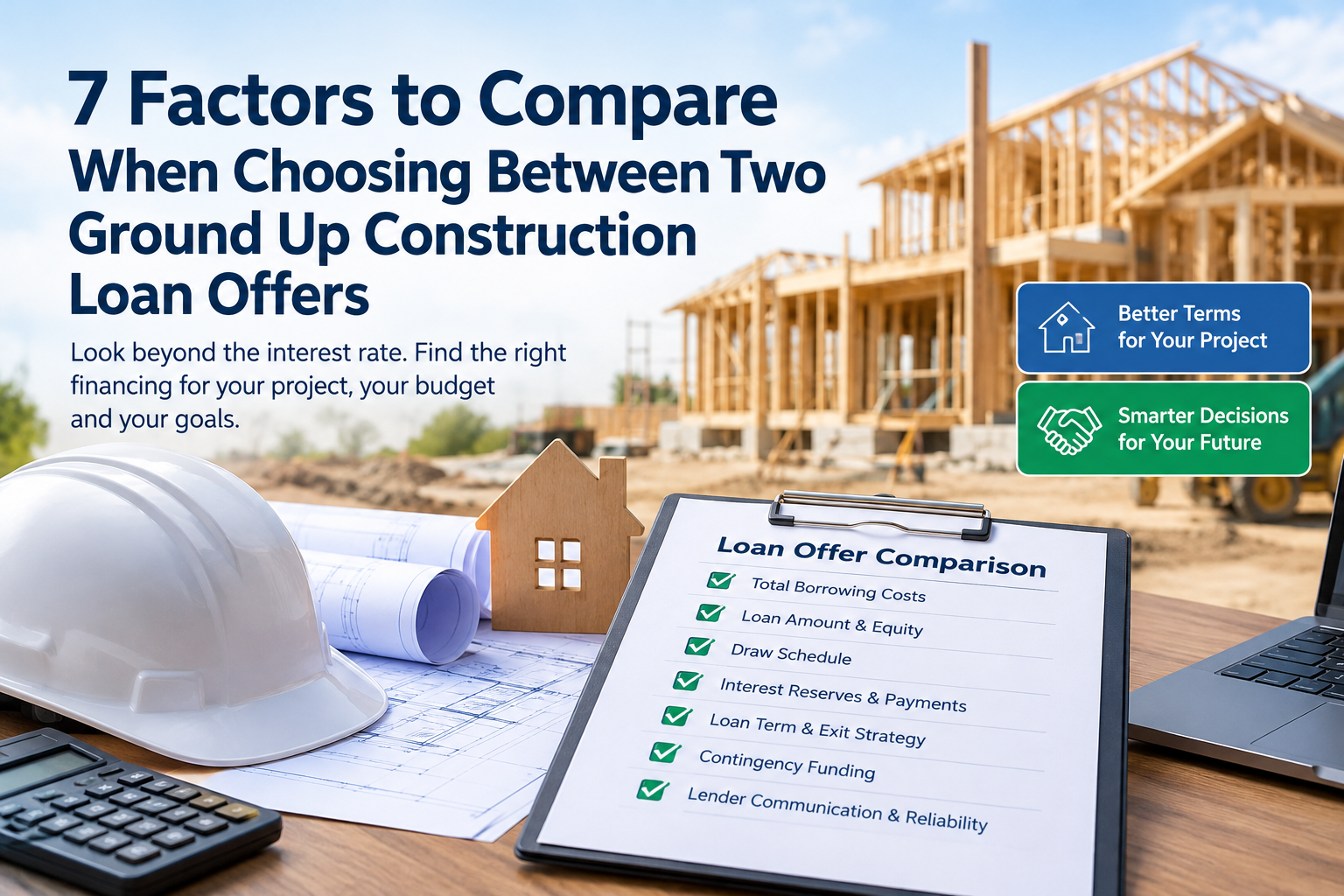
Choosing between two ground up construction loan offers can be more difficult than it first appears. One lender may offer a lower interest rate, while another may provide more usable funds, a smoother draw process, or better flexibility if construction takes longer than expected.
For real estate investors in the United States, the right financing is not simply the loan with the lowest advertised rate. It is the loan that supports the project’s budget, keeps construction moving, and provides a realistic path to repayment.
Ground up construction loans help investors finance new properties built from the ground up. Depending on the lender and loan structure, financing may cover land acquisition, construction costs, permits, architectural work, and other eligible expenses. Funds are often released in stages as work progresses rather than being provided entirely at closing.
Before choosing between two ground up construction lenders, investors should look beyond the headline numbers. The following seven factors can help you compare offers and understand which financing arrangement better fits your project.
1. Compare the Total Cost of Borrowing, Not Just the Interest Rate
Interest rates are an important starting point, but they do not tell you the entire cost of a construction loan. Two lenders can offer similar rates while charging different fees or structuring interest payments differently.
When reviewing ground up construction financing, examine the following expenses:
- Interest rate and whether it is fixed or variable.
- Origination fees and loan processing charges.
- Appraisal, inspection, and draw fees.
- Legal, documentation, and closing expenses.
- Extension fees if the project needs additional time.
- Prepayment penalties or other early repayment charges.
You should also determine whether interest is charged on the amount actually drawn or on the full loan commitment. This difference can significantly affect borrowing costs during the early stages of construction.
For example, imagine that one lender offers a rate of 10 percent while another offers 10.5 percent. The second lender may initially appear more expensive. However, if the first lender charges substantial draw fees and a higher origination fee, its total cost could be greater.
Ask both lenders to provide an itemized estimate of the expected borrowing costs. Where possible, compare the costs over the same expected construction period and under the same assumptions about when funds will be drawn.
Practical tip: Request a written breakdown of all lender fees before signing a term sheet. Do not assume that an expense is included simply because it was not mentioned in the initial quotation.
2. Evaluate the Loan Amount and the Cash You Must Contribute
The second factor is how much financing you can actually use for your project.
A lender may advertise a large maximum loan amount, but the amount approved for your specific property depends on several factors. These can include the total project cost, the expected value after construction, your available equity, the property type, and your financial profile.
Ground up construction lenders commonly consider measures such as loan to cost and loan to value.
Loan to cost compares the proposed loan amount with the eligible total project cost. Loan to value compares the loan amount with a property’s appraised value. For a development project, the lender may use the projected value after construction, subject to its underwriting rules.
For example, suppose your project has an eligible total cost of $500,000.
Lender A offers $400,000, while Lender B offers $425,000. At first glance, Lender B appears more attractive because it requires less initial cash.
However, you should also check whether the quoted amounts include land costs, eligible soft costs, construction expenses, and interest reserves. A larger commitment does not necessarily mean more money will be available to pay contractors.
Consider these questions before choosing an offer:
- How much cash must I contribute before construction begins?
- Can the equity in land I already own count toward my contribution?
- Are previously paid project expenses eligible for reimbursement?
- Is the interest reserve included within the maximum loan amount?
- Will the lender finance the entire approved construction budget or only certain costs?
A loan that requires less cash at closing may still create cash flow pressure later if you must pay for early construction work before receiving a draw.
Choose an offer that matches your available capital and leaves enough liquidity to handle unexpected expenses.
3. Understand the Construction Draw Schedule
The draw schedule is one of the most important parts of a construction loan agreement. It determines how and when you receive funds as your project progresses.
Unlike a conventional mortgage, many ground up construction loans release money in stages. The lender may require a draw request, supporting invoices, an inspection, and other documentation before releasing each payment.
The process can affect your relationship with contractors, your ability to purchase materials, and your overall construction timeline.
When comparing two offers, examine the following details:
Draw frequency: Does the lender allow requests whenever eligible work is completed, or does it require specific milestones?
Inspection requirements: Is an inspection required for every draw? Who arranges it, and who pays the cost?
Funding turnaround: How long does the lender typically take to release approved funds after receiving complete documentation?
Eligible expenses: Can you request funds for permits, materials, labor, and other approved project costs?
Payment method: Does the lender reimburse expenses already paid, pay contractors directly, or allow advances for certain costs?
These differences matter because contractors may expect payment according to their contracts rather than your lender’s inspection schedule.
Imagine that your contractor completes foundation work and submits a payment request. If one lender has a clear inspection process and another requires additional documentation that was not explained upfront, the second process could create delays.
Ask both lenders to explain their draw procedures in writing. If possible, obtain a sample draw schedule and a list of required documents before closing.
A loan with a slightly higher rate may be worth considering if its funding process better matches your construction plan. However, confirm the actual process and expected turnaround instead of relying on verbal assurances.
4. Compare Interest Reserves and Payment Requirements
Construction projects may take months to complete, and interest expenses can increase as more loan funds are drawn. Investors should understand how these payments will be handled throughout the project.
Some ground up construction financing arrangements include an interest reserve. This is an amount set aside to cover scheduled interest payments during a specified period. The reserve may be funded from loan proceeds, depending on the agreement.
An interest reserve can reduce the need to make monthly interest payments from personal or business funds during construction. However, it is not free money. If the reserve is part of the approved loan amount, it reduces the portion available for other project expenses.
For example, suppose you receive a construction loan commitment of $400,000, including a $25,000 interest reserve. If that reserve is deducted from the amount available for construction, you cannot assume that the entire $400,000 will be available for building work.
Ask each lender these questions:
- Is interest charged on the full commitment or only on drawn funds?
- Is an interest reserve required?
- Is the reserve included within the maximum loan amount?
- How long is the reserve expected to last?
- What happens when the reserve is exhausted?
- Are payments required during construction even when the property produces no income?
You should also estimate the interest expense if construction takes longer than planned. A delay can increase the amount of interest owed and leave you with less cash for other expenses.
Compare the payment requirements against your project cash flow. The better offer is one you can manage even if construction takes longer or the reserve does not cover the entire building period.
5. Review the Loan Term, Extension Options, and Exit Strategy
A construction loan needs a realistic repayment plan. Before accepting an offer, understand when the loan matures and how you intend to repay it.
Real estate investors commonly plan to repay construction financing by selling the completed property or refinancing it into longer term financing. The appropriate strategy depends on the property, market conditions, rental income potential, and investment objectives.
For example, an investor building a rental property may plan to refinance into a rental loan after construction is complete. An investor developing a property for resale may expect to repay the construction loan from the sale proceeds.
Neither strategy is guaranteed to work exactly as planned.
Construction may take longer than expected. Property values may change. Buyers may take more time to purchase the completed property. A refinance may also be delayed if the finished property does not meet the next lender’s requirements.
When comparing offers, review:
- The original loan term and maturity date.
- Whether extensions are available.
- Extension fees and additional conditions.
- Whether the interest rate changes during an extension.
- Any minimum interest or early repayment charges.
- The consequences of failing to repay by maturity.
Do not assume that an extension is automatic. The lender may require additional documentation, evidence of construction progress, updated financial information, or payment of fees.
Build a reasonable time buffer into your project schedule. If your construction plan estimates completion in ten months, consider whether a loan with a twelve month term leaves enough time for final inspections, marketing, sale, or refinancing.
The best offer should support a credible exit strategy without forcing you to depend on an unusually fast sale or an uncertain refinance.
6. Examine Contingency Funding and Flexibility for Cost Overruns
Even a carefully planned construction project can encounter unexpected expenses. Material prices may rise, site conditions may differ from expectations, or the contractor may discover work that was not included in the original estimate.
These problems can affect both your budget and your ability to finish construction.
When comparing ground up construction lenders, find out how each lender handles cost overruns and changes to the approved budget.
Some lenders may require a contingency amount within the project budget. Others may impose restrictions on how contingency funds can be used or whether money can be moved between budget categories.
Ask the lenders:
- Is a contingency reserve required?
- What expenses qualify for contingency funding?
- Can funds be moved between approved budget categories?
- What happens if a major expense exceeds the contingency?
- Will additional borrower equity be required?
- Does the lender need to approve contractor changes before work begins?
Consider a project with a construction budget of $350,000. During construction, unexpected drainage work adds $15,000 to the cost. If you have adequate contingency funds and a clear approval process, the additional expense may be manageable.
Without sufficient reserves, you may need to contribute more cash, renegotiate the scope of work, or seek additional financing. Additional funding is not guaranteed, and it may take time to arrange.
Compare the flexibility offered by each lender, but do not treat flexibility as permission to spend without approval. Confirm the procedures for documenting and approving changes before committing to a contractor.
A sound financing arrangement should give you a clear understanding of how unexpected expenses will be handled.
7. Assess Lender Communication, Documentation, and Reliability
The final factor is the quality of the lending process itself.
Construction financing requires coordination among the borrower, lender, contractor, inspectors, title professionals, and other parties. Clear communication can help keep this process organized, particularly when a draw request or construction decision needs quick attention.
A lender may offer attractive financial terms but provide limited information about documentation, inspections, or funding timelines. That uncertainty can make project management more difficult.
Before choosing an offer, evaluate how each lender handles communication and loan administration.
Consider these questions:
- Do you have a clear point of contact?
- Does the lender explain its underwriting conditions?
- Are loan fees and restrictions disclosed in writing?
- Is there a defined process for submitting draw requests?
- Can the lender explain what may delay funding?
- Are closing requirements and expected timelines clearly communicated?
You can also ask for an explanation of the lender’s process for resolving documentation problems or responding to a delayed inspection.
Do not judge reliability only by how quickly a lender responds before you apply. Ask specific questions and assess whether the answers are consistent, detailed, and supported by written terms.
You should also review the lender’s legal identity, licensing or registration requirements where applicable, and the final loan documents with qualified professionals when needed.
A professional lending relationship cannot eliminate construction risks. However, clear expectations and a well defined process can make it easier to manage them.
Example: How to Compare Two Ground Up Construction Loan Offers
Consider an investor planning to build a single family rental property with a total eligible project cost of $500,000.
The investor receives two hypothetical offers.
| Factor | Lender A | Lender B |
|---|---|---|
| Interest rate | 10 percent | 10.5 percent |
| Loan commitment | $400,000 | $425,000 |
| Origination fee | 2 percent | 1.5 percent |
| Draw process | More restrictive | More flexible |
| Interest reserve | Included in commitment | Included in commitment |
| Extension terms | Limited options | Extension available subject to approval |
These figures are illustrative and do not represent current market quotes.
Lender A offers a lower interest rate, but Lender B offers a larger commitment, a lower origination fee, and more flexible draw procedures.
The investor should not automatically select either lender. The next step is to calculate the actual amount available for construction, estimate total borrowing costs, review extension conditions, and check whether the draw schedule matches the contractor’s payment requirements.
The investor should also confirm that the expected rental income and refinance assumptions support repayment.
This comparison demonstrates why the lowest interest rate is not always the best overall choice. The right offer depends on the complete loan structure and the project’s financial needs.
Final Thoughts
Choosing between two ground up construction loan offers requires more than comparing interest rates. Investors should evaluate the total cost of borrowing, usable loan proceeds, draw procedures, interest reserves, repayment terms, contingency funding, and lender communication.
The goal is to secure financing that fits the project from the first construction expense through completion and repayment.
Before signing, request written terms from both ground up construction lenders and compare them using the same project assumptions. Review the complete loan agreement, not just the initial quotation. If a term is unclear, ask for clarification before committing.
Careful comparison can help you avoid unexpected costs, manage construction cash flow, and make a more informed real estate investment decision.
Frequently Asked Questions
1. What should I compare when choosing between two ground up construction loans?
Compare the interest rate, total fees, loan amount, borrower equity requirements, draw schedule, interest reserve, loan term, extension options, and repayment conditions. Also consider how quickly approved draws are funded and whether the lender’s procedures fit your construction timeline.
2. Is a lower interest rate always the better construction loan option?
No. A lower rate may be offset by higher origination fees, inspection charges, restrictive draw procedures, or expensive extension terms. Compare the total expected borrowing cost and the amount of usable construction funding before making a decision.
3. How do lenders determine the amount available for ground up construction financing?
Lenders may evaluate total project cost, projected completed value, borrower equity, credit history, construction experience, contractor qualifications, and the project budget. Loan to cost and loan to value limits may also affect the approved amount. Requirements vary by lender and project.
4. What is an interest reserve in a construction loan?
An interest reserve is money set aside to pay scheduled loan interest during a specified period. It may be included in the loan commitment and can reduce the funds available for construction. Borrowers should confirm how long the reserve is expected to last and who pays interest after it runs out.
5. How do construction loan draws work?
Construction loan draws release funds in stages as eligible work is completed. Depending on the agreement, the borrower may submit invoices, payment records, lien waivers, and inspection requests. The lender reviews the documentation before authorizing a draw.
6. Can I negotiate the terms of a ground up construction loan?
Potentially. Depending on the lender and project, you may be able to discuss the interest rate, fees, loan amount, draw procedures, extension options, or other terms. Any agreed changes should appear in the written loan documents before you sign.
7. What happens if construction costs exceed the approved budget?
The borrower may need to use contingency funds, contribute additional equity, reduce project expenses, or request an approved budget change. Additional lender funding is not guaranteed. Investors should understand the lender’s cost overrun policy before construction begins.
8. How long should a ground up construction loan last?
The appropriate term depends on the project’s size, construction schedule, permitting requirements, and exit strategy. Investors should allow time for construction, inspections, completion, and the planned sale or refinance. The loan agreement should clearly state the maturity date and any extension conditions.
9. Should I choose a construction lender based on funding speed?
Funding speed matters, especially when contractors and suppliers need timely payment. However, investors should verify the lender’s draw requirements, typical processing times, inspection procedures, and fees. A fast initial approval does not necessarily mean every construction draw will be released quickly.
10. What documents should I review before accepting a construction loan offer?
Review the term sheet, complete loan agreement, fee schedule, draw procedures, approved project budget, interest reserve provisions, maturity date, extension conditions, and repayment requirements. Ask a qualified real estate attorney or financial professional to review unclear or significant contractual terms before closing.
Leave a Reply