Getting the right financing is an important part of a successful real estate investment. Whether you are purchasing an investment property, renovating a house, or funding a property that needs major repairs, choosing the right lender can make a big difference to your project’s success.
A private money lender for real estate investors can provide financing for property purchases, renovations, and other investment projects. Many investors choose private money lending because it can offer flexible loan structures and financing options that fit their investment plans. However, before accepting an offer from private money lenders, it is important to understand the loan terms, fees, and repayment conditions.
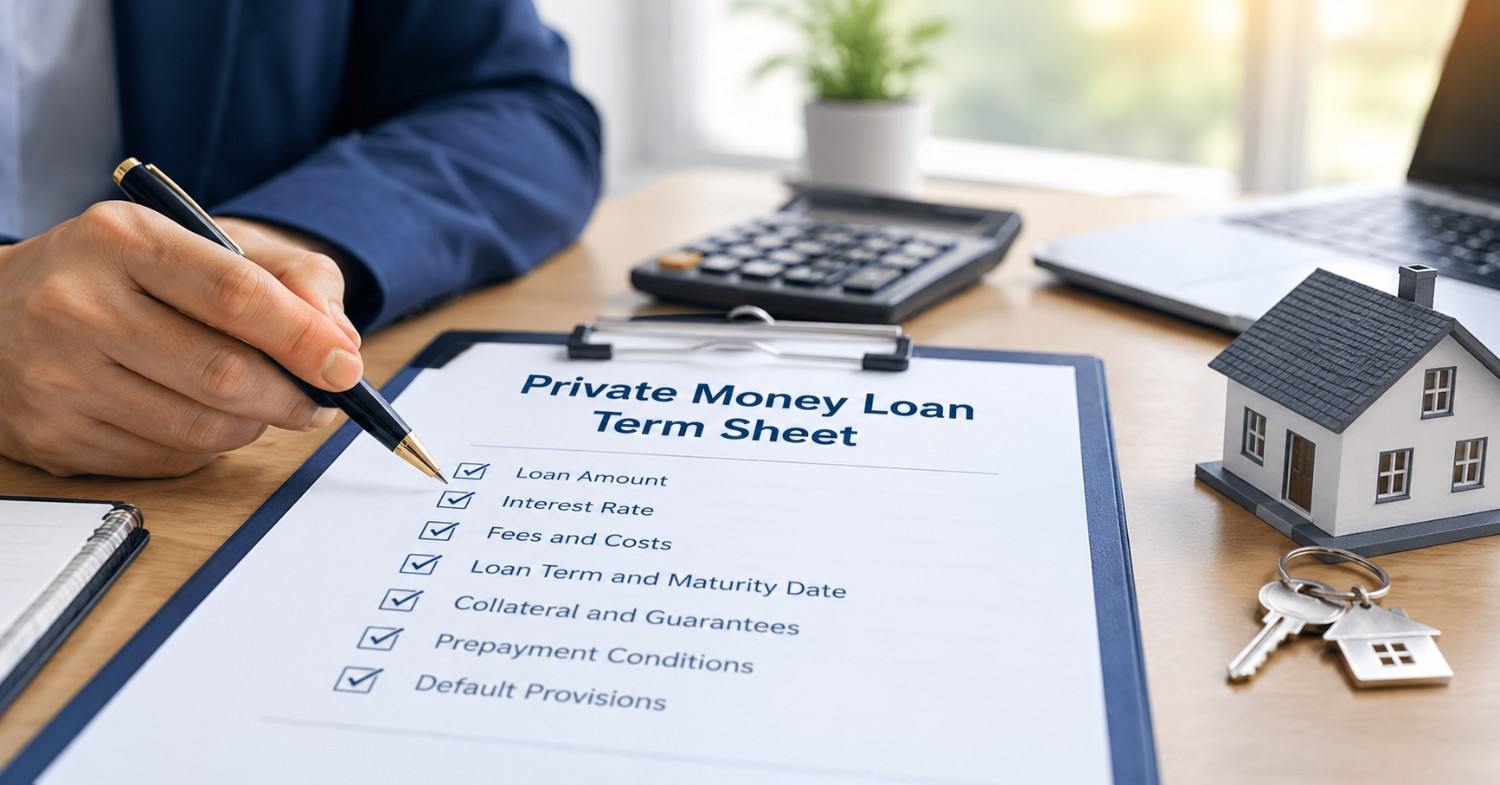
One document that deserves special attention is the private money loan term sheet. It provides an overview of the proposed financing, including the loan amount, interest rate, fees, repayment period, property security, and other important conditions.
Looking only at the interest rate or approved loan amount is not enough. Other conditions can affect your total borrowing costs, available funds, and repayment responsibilities.
If you are comparing private money loans, here are seven important things to review in a loan term sheet before making a financing decision.
What Is a Private Money Loan Term Sheet?
A private money loan term sheet is a written summary of the main conditions of a proposed loan. It explains what a lender is offering and what the borrower may need to agree to before receiving financing.
For example, an investor purchasing a property for renovation may receive a term sheet that explains the loan amount, interest rate, renovation funding, repayment period, and property security requirements.
The document helps both parties understand the proposed financing structure before preparing the complete loan agreement.
A term sheet is usually an initial outline rather than the final loan contract. Its legal effect depends on its wording and applicable state law. Some conditions may be binding even when the main loan terms are not.
The final loan documents may also contain additional requirements. Therefore, borrowers should review both the term sheet and the complete loan agreement before signing.
1. Review the Loan Amount and Financing Structure
The first thing to check is how much money the lender is offering and how the financing will be provided.
Private money lenders may calculate the loan amount using the property’s purchase price, current market value, estimated value after repairs, or total project cost.
Understanding this calculation helps you determine whether the proposed financing will cover your investment needs.
Understand How Much Funding You Will Receive
Consider an investor purchasing a property for $250,000 and planning to spend another $50,000 on renovations. The total project cost is $300,000.
A lender may agree to finance part of the purchase price and provide additional funds for approved renovation expenses. However, the entire approved amount may not be available at closing.
Some private money loans include renovation funds that are held back and released as work progresses. This means you may receive the purchase financing first and access the remaining funds through a draw process.
Before accepting the offer, check these details:
Total loan amount: Confirm the maximum amount the lender is willing to provide. Check whether it includes both purchase financing and renovation funds.
Initial funding: Find out how much money will actually be available at closing after fees and other deductions.
Loan to value: Understand whether the lender calculates financing based on the property’s current market value.
Loan to cost: Check how much of the total eligible project cost the lender is willing to finance.
After repair value: If the property needs improvements, find out whether the lender considers its estimated value after renovations.
Check How and When Funds Are Released
Another important detail is the timing of funding. Renovation money may be released in stages instead of being provided as one payment.
For example, the lender may require completed work and an inspection before releasing the next portion of the renovation funds.
This arrangement can affect how you pay contractors and manage your project budget.
Also confirm whether the loan amount can change after the property appraisal or final loan review.
Question to ask the lender: How much money will I receive at closing, and how much will be released later?
2. Understand the Interest Rate and How Interest Is Calculated
The interest rate is one of the most important parts of a private money loan. It determines how much you pay for borrowing money over the loan period.
However, investors should not look at the percentage alone. It is equally important to understand how interest is calculated and when payments are due.
Private money lending often involves short term financing. Depending on the loan structure, payments may cover interest only or both principal and interest.
Check Whether the Interest Rate Is Fixed or Variable
A fixed interest rate generally stays the same throughout the agreed loan period. A variable rate can change based on a market index or another agreed rate calculation.
Before accepting an offer, confirm which type of rate applies.
Also check whether the rate can change after an extension or if certain loan conditions are not met.
Understand Your Monthly Interest Payments
Consider a borrower who takes a $200,000 loan with an annual interest rate of 12 percent.
If interest is calculated monthly on the full outstanding principal using a simple interest calculation, the monthly interest payment would be approximately $2,000.
However, the actual payment may differ depending on the loan structure and how much money has been released.
Review these additional details:
Interest calculation: Confirm whether interest is charged on the full approved amount, the amount already funded, or the remaining loan balance.
Payment schedule: Check whether payments are due monthly or according to another schedule.
Interest only payments: Find out whether you only need to pay interest during the loan period or whether principal payments are also required.
Default interest: Understand whether a higher rate applies if you fail to meet certain loan conditions.
Another important detail is when interest begins. It may start at closing, when funds are released, or according to another condition in the loan documents.
These differences can affect your total borrowing costs, especially when renovation funds are released over several months.
Question to ask the lender: Is interest charged on the full approved loan amount or only on the money that has been funded?
3. Check All Fees and Additional Financing Costs
The interest rate does not represent the complete cost of a private money loan.
There may be several additional charges that increase your borrowing expenses. These costs can reduce the money available for purchasing or improving the property.
For this reason, carefully review the fee section of your term sheet.
Understand the Common Loan Fees
Some common charges associated with private money loans include:
Origination fees: These are charges for arranging and setting up the loan. They are often calculated as a percentage of the loan amount and expressed in points.
Underwriting fees: These charges may cover the lender’s review of your financial details, property information, and investment plans.
Processing fees: These may cover the administrative work involved in preparing and processing the loan.
Appraisal fees: The lender may require a property valuation to understand its current market value or estimated value after renovation.
Title and closing costs: These may include title searches, title insurance, recording charges, and other settlement expenses.
Draw inspection fees: If your loan includes renovation funding, the lender may charge for inspections before releasing additional money.
Extension fees: If you need more time to repay the loan, the lender may charge an additional amount for extending the repayment period.
Exit fees: Some loan arrangements include an additional charge when the borrower repays the loan.
Not every lender charges all these fees. The amounts and payment conditions can also vary from one transaction to another.
Calculate the Total Cost of Borrowing
Consider an investor who receives a $250,000 loan offer. The term sheet includes a 2 percent origination fee, a $750 processing fee, and estimated third party closing expenses of $2,000.
The origination fee alone would be $5,000. When the other expenses are included, the total upfront financing costs would be $7,750.
This example shows why investors should calculate the complete cost rather than compare lenders only by interest rate.
Also check which fees are refundable if the transaction does not close. Some expenses may remain your responsibility even if the loan does not move forward.
Question to ask the lender: Can you provide a complete written breakdown of lender fees, third party expenses, and all charges due before or at closing?
4. Review the Loan Term, Maturity Date, and Extension Options
The loan term explains how long you have to repay the borrowed money.
Many private money loans are designed for short term real estate investment projects. An investor may use this financing to purchase and renovate a property before selling it or refinancing into a longer term loan.
However, real estate projects do not always follow the original schedule.
Renovations may take longer than expected. Contractors may become unavailable. Permit approvals can be delayed. A property may also take more time to sell.
If your loan reaches its maturity date before you complete your investment plan, you could face additional expenses or repayment difficulties.
Understand the Loan Maturity Date
The maturity date is the date when the outstanding loan balance must be repaid according to the loan documents.
Review the following details:
Initial loan term: Confirm whether the financing is for six months, twelve months, eighteen months, or another period.
Maturity date: Check the exact date when the loan must be repaid.
Repayment requirements: Understand whether the full balance must be paid at the end of the loan term.
Extension options: Find out whether additional time is available if your project takes longer than expected.
Check the Conditions for Loan Extensions
An extension may provide extra time to complete a renovation, sell a property, or arrange new financing.
However, extensions are not always automatic.
The lender may require timely payments, active insurance coverage, updated project details, or other conditions before approving additional time.
You should also check whether an extension fee applies and whether the interest rate changes during the extended period.
For example, suppose you take a twelve month private money loan to renovate and sell a property. Renovation work takes ten months, and you need another three months to find a buyer and complete the sale.
Without a suitable extension option, you may need to arrange alternative financing or repay the outstanding balance before the property sells.
It is better to understand these conditions before closing rather than negotiate an extension when the maturity date is approaching.
Question to ask the lender: What options are available if my project takes longer than expected, and what conditions must I meet to qualify for an extension?
5. Understand Collateral Requirements and Personal Guarantees
Collateral is another important part of a private money loan term sheet.
In many real estate investment transactions, the property being financed serves as security for the loan. The lender generally records a mortgage or deed of trust against the property, depending on the state.
This gives the lender certain legal rights if the borrower fails to meet the loan obligations.
However, investors should understand exactly which assets are being used as security and whether additional requirements apply.
Check Which Property Will Secure the Loan
Review these details carefully:
Property used as collateral: Confirm the exact property securing the loan and make sure its legal description is correct.
Lien position: Check whether the lender will hold a first lien or second lien position. A first lien generally has priority over later recorded liens, subject to applicable law and other interests.
Additional collateral: Find out whether the lender requires security in another property or asset.
Cross collateralization: Check whether multiple properties are being used to secure one loan or several loans.
These conditions can affect your ability to sell, refinance, or use the properties for other financing arrangements.
Understand Personal Guarantee Requirements
A personal guarantee is a promise by an individual to take responsibility for certain loan obligations if the borrowing business fails to meet them.
This is particularly important for investors purchasing properties through a limited liability company.
For example, an investor may establish an LLC to purchase and renovate an investment property. Although the LLC is the borrower, the lender may also require the investor to sign a personal guarantee.
This means the investor could have personal financial exposure if the LLC fails to meet the guaranteed obligations.
The exact exposure depends on the guarantee language and applicable law.
Before signing, check whether the guarantee covers the full loan amount or only certain obligations. Also review any exceptions related to fraud, misrepresentation, misuse of funds, or other specified events.
Do not assume that purchasing through an LLC automatically protects all personal assets from loan related claims.
Question to ask the lender: Does the loan require a personal guarantee, and exactly which properties or assets will secure the financing?
6. Check Prepayment Conditions and Repayment Requirements
Many real estate investors plan to repay their private money loans as soon as their investment projects are completed.
For example, a house flipper may want to sell a renovated property within six months and use the sale proceeds to repay the loan.
Another investor may plan to refinance the property into a long term rental loan after completing renovations.
However, the ability to repay a loan early depends on the conditions mentioned in the term sheet and final loan documents.
Some private money loans allow early repayment without an additional penalty. Others may include minimum interest requirements or additional charges.
Understand Early Repayment Conditions
Before accepting an offer, review the following:
Prepayment penalty: Check whether the lender charges an additional amount if you repay the loan before its maturity date.
Minimum interest requirement: Some agreements require borrowers to pay interest for a minimum number of months, even if the loan is repaid earlier.
Exit fee: Determine whether an additional charge applies when the loan is paid off.
Payoff statement: Understand how to request the final amount needed to repay the loan.
Payment application: Confirm how payments are applied to interest, principal, fees, and other outstanding amounts.
Check the Process for Releasing the Property Lien
After the loan is fully repaid, the lender generally needs to release its mortgage or deed of trust according to the applicable state requirements.
Ask how the payoff process works and when the required release documents will be provided.
For example, suppose an investor takes a private money loan with a six month minimum interest requirement. The property is sold after four months.
Even though the investor is ready to repay the loan, the agreement may require payment of six months of interest.
This can reduce the profit earned from the investment.
The important point is to understand your expected holding period and compare it with the repayment conditions.
If you plan to sell or refinance quickly, early repayment flexibility may be particularly valuable.
Question to ask the lender: Can I repay the loan early without a penalty, and is there any minimum interest requirement?
7. Read Default Conditions and Other Important Loan Requirements
The final step is to review what happens if you fail to meet the loan requirements.
Investors sometimes focus so much on getting approved that they overlook the conditions that apply after closing.
However, default provisions can have serious financial consequences.
A loan default does not always happen because a borrower misses a monthly payment. Depending on the agreement, other situations may also create a default.
Understand Common Loan Default Situations
These situations may include:
Missed payments: Failing to make interest or principal payments according to the agreed schedule.
Failure to repay: Not paying the outstanding balance by the maturity date.
Insurance problems: Allowing required property insurance to expire or failing to maintain the required coverage.
Unpaid property taxes: Failing to pay property taxes when required.
Unauthorized property transfers: Selling or transferring the property without obtaining required lender approval.
Misuse of loan funds: Using borrowed money for purposes that are not permitted under the loan agreement.
Failure to meet other obligations: Not complying with reporting requirements, construction conditions, or other agreed responsibilities.
The term sheet may summarize these conditions, but the complete loan documents usually contain more detailed default language.
Review the Lender’s Rights and Your Responsibilities
You should also review these important conditions:
Default interest: Check whether a higher interest rate applies after a default and when it begins.
Late payment charges: Understand whether additional fees apply when payments are received after the due date.
Cure period: Find out whether you have a specified period to correct certain problems before further action can be taken.
Acceleration clause: Check whether the lender can demand immediate repayment of the outstanding loan balance following a default.
Foreclosure rights: Understand the lender’s rights to enforce its security interest under the loan documents and applicable state law.
For example, suppose an investor takes a twelve month loan but cannot sell the property before the maturity date. If the loan is not extended and the balance remains unpaid, the borrower may be in default.
Depending on the agreement and applicable law, the lender may have the right to pursue available remedies, including foreclosure.
Investors should never assume that a lender will automatically provide extra time if a project runs behind schedule.
Reviewing default conditions helps you understand your responsibilities and the possible consequences of failing to meet them.
Question to ask the lender: What events can trigger a default, what opportunities do I have to correct a problem, and what remedies can the lender pursue?
Additional Tips for Comparing Private Money Loan Term Sheets
If you receive financing offers from multiple private money lenders, avoid selecting an offer simply because it has the lowest interest rate or highest loan amount.
Instead, compare the complete financing structure and determine which offer best supports your investment plan.
Compare the Same Loan Amount and Project Costs
Make sure each lender is evaluating the same purchase price, renovation budget, and project requirements.
This makes it easier to understand why one lender may offer a different amount from another.
Calculate the Complete Financing Cost
Include interest, origination fees, closing expenses, draw fees, extension charges, and possible prepayment costs.
Looking at all these expenses gives you a better idea of the actual cost of borrowing.
Check the Funding Schedule
Compare how much money will be available at closing and how much will be released later.
A higher loan commitment does not always mean more money will be available immediately.
Review Repayment Flexibility
Consider whether the maturity date and early repayment conditions match your investment strategy.
A loan that allows enough time to complete your project may be more useful than one with a lower rate but a very short repayment period.
Understand the Legal Requirements
Compare lien positions, personal guarantees, additional collateral, and default conditions.
Make sure you understand your responsibilities before accepting an offer.
Review the Final Loan Documents
The final promissory note, mortgage or deed of trust, guarantee, and other closing documents should be reviewed carefully.
Check that the final terms match what you understood when accepting the offer.
A qualified real estate attorney familiar with private lending transactions in the property’s state can help identify unclear or unfavorable conditions.
Final Thoughts
A private money loan term sheet tells you much more than how much a lender is willing to finance. It explains the proposed cost of borrowing, repayment expectations, property security, and other conditions that can affect your real estate investment.
Before moving forward, carefully review the loan amount, interest rate, fees, maturity date, collateral, repayment conditions, and default provisions.
Pay particular attention to details that could increase your costs or limit your flexibility. If something is unclear, ask the lender for a written explanation before signing.
Private money loans can be useful financing options for real estate investors, but the right loan should fit your project’s budget, timeline, and repayment plan.
Taking time to understand the terms before closing can help you avoid unexpected expenses and make a more informed financing decision.
If you are considering private money financing for your next real estate investment, discuss the proposed loan structure, funding requirements, and repayment plan with your lender before moving forward.
Frequently Asked Questions
1. What should I look for in a private money loan term sheet?
You should review the loan amount, interest rate, origination fees, closing costs, loan term, maturity date, collateral requirements, personal guarantees, prepayment conditions, and default provisions. Also confirm how funds will be released and whether extension options are available.
2. Is a private money loan term sheet legally binding?
A private money loan term sheet is generally an outline of proposed financing terms and is often nonbinding regarding the main loan commitment. However, certain provisions may be legally binding depending on the wording and applicable state law. Always review the document carefully before signing.
3. What fees should I check before accepting a private money loan?
Common fees include origination points, underwriting charges, processing fees, appraisal expenses, title and closing costs, draw inspection fees, extension fees, and possible exit fees. Ask for a complete written fee breakdown before accepting the financing offer.
4. Can I negotiate the terms offered by private money lenders?
Yes. Many loan terms may be open to discussion depending on the lender, transaction, property, and borrower’s qualifications. You can ask about the interest rate, origination points, loan amount, maturity date, extension options, prepayment conditions, and fees before accepting an offer.
5. What is the difference between a private money loan term sheet and a loan agreement?
A term sheet summarizes the proposed financing arrangement, including the main financial and lending conditions. A loan agreement and related closing documents provide the detailed contractual terms, borrower responsibilities, lender rights, repayment requirements, and legal provisions governing the transaction.
6. Do private money lenders require personal guarantees?
Some private money lenders require borrowers to provide personal guarantees, particularly when an LLC or another business entity is borrowing the money. The guarantee may cover the full loan or certain specified obligations. Requirements vary by lender and transaction.
7. What happens if I cannot repay a private money loan by the maturity date?
If you cannot repay the loan by its maturity date, you may be able to request an extension if the loan terms allow it and the lender approves. Otherwise, the loan may go into default, potentially resulting in additional interest, fees, and legal enforcement actions. Discuss repayment or refinancing options with your lender before the maturity date.
8. Can I pay off a private money loan before the maturity date?
Early repayment is possible under many private money loan arrangements. However, some agreements include prepayment penalties or minimum interest requirements. Review the repayment provisions and confirm the exact payoff amount with the lender before making an early payment.
9. What is an origination fee in private money lending?
An origination fee is a charge imposed by a lender for arranging and setting up a loan. It is often expressed in points, with one point generally representing one percent of the applicable loan amount. Confirm the amount used to calculate the fee and when payment is required.
10. Should I have an attorney review a private money loan term sheet?
Yes. Having a qualified real estate attorney review the term sheet and complete loan documents can help you understand your financial obligations, collateral requirements, guarantees, default provisions, and other legal conditions. This is especially important when the loan involves multiple properties, personal guarantees, or complex financing arrangements.
Leave a Reply