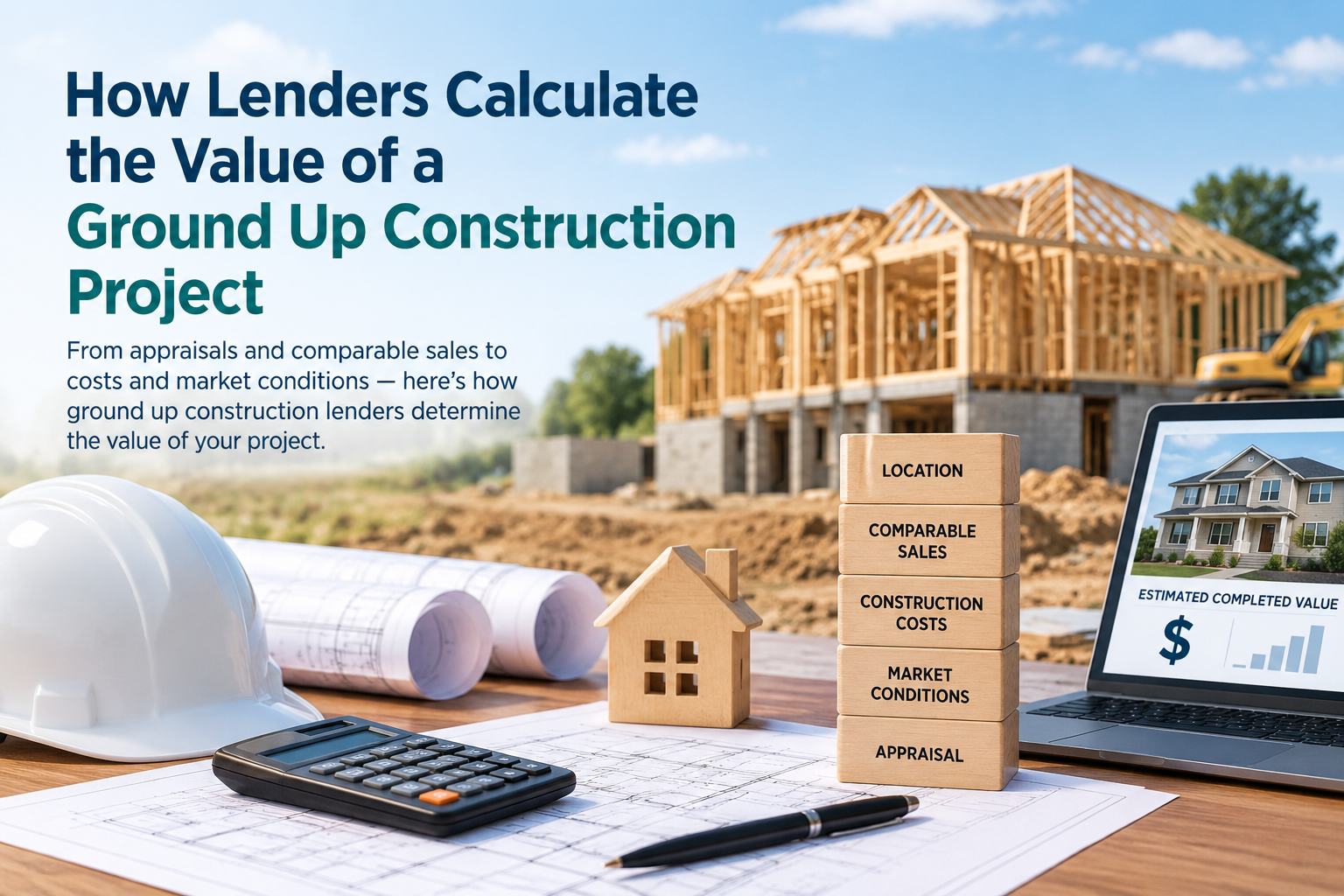
When you apply for ground up construction loans, one of the most important numbers in the entire loan request is the expected value of the property after construction is complete.
This number matters because a lender is not only asking how much it will cost to build the property. The lender also needs to understand what the finished property could reasonably be worth in the market.
A project can have a detailed construction budget and still face financing challenges if the expected completed value does not support the requested loan amount.
Ground up construction lenders usually review the land, plans, construction budget, builder, market conditions, and expected completed value together. An appraisal is an important part of this process. For regulated construction lending, appraisal guidance recognizes both the current value of the property and the prospective market value after completion.
Understanding how this value is calculated can help real estate investors prepare a stronger financing request and avoid surprises during underwriting.
What Does Completed Value Mean?
Completed value is the estimated market value of a property after the planned construction has been finished according to the approved plans and specifications.
For example, imagine an investor owns a vacant lot in Houston and plans to build a new single family home. The lot may have a current market value of $150,000. The investor may expect to spend another $400,000 on construction and related project costs.
The finished property might not be worth $550,000 simply because that is the amount invested.
An appraiser looks at the market and asks a different question:
What would a typical buyer reasonably pay for this completed property?
That distinction is extremely important.
A project costing $550,000 to complete could have a completed market value of $650,000, $550,000, or even less than the total project cost.
The market determines value. Construction cost is only one piece of the analysis.
Current appraisal guidance recognizes that proposed construction requires a prospective value analysis based on the planned finished property.
Why Completed Value Matters to Construction Lenders
Ground up construction financing involves more uncertainty than financing an existing property.
The building may not exist yet. There may be no operating history, no rental history, and no finished property to inspect.
That means lenders need to evaluate what the collateral is expected to be worth when construction is finished.
The completed value can influence the amount a lender is willing to finance.
A lender may use a loan to cost calculation based on the total project cost. The lender may also apply a loan to value limit based on the appraised completed value.
For example:
Total project cost: $800,000
Potential loan based on an 80 percent loan to cost limit: $640,000
Completed appraised value: $950,000
If the lender uses a 70 percent completed value limit, the value based loan limit would be $665,000.
In this example, the $640,000 loan to cost calculation would produce the lower amount.
The exact limits vary by lender, property type, market, borrower experience, and overall project risk. There is no universal construction loan percentage that applies to every project.
The important point is that lenders may evaluate both the cost of creating the property and the value of the finished collateral. Current industry lending guidance commonly describes this two part approach.
How Is the Value of a Ground Up Construction Project Calculated?
The value is normally supported by an appraisal and market analysis.
The appraiser reviews the proposed property and estimates what it would likely sell for once completed.
Several factors can influence the final opinion of value.
1. Location
Location is one of the most important factors in real estate valuation.
Two homes with identical floor plans and similar construction costs can have very different values if they are located in different neighborhoods.
The appraiser may consider:
Neighborhood quality
Nearby employment centers
Schools and other community amenities
Transportation access
Shopping and services
Lot characteristics
Local housing demand
Recent development
Property taxes
Zoning
Market trends
The location also affects which comparable properties can be used.
A builder might believe that a particular design should be worth $750,000 because of the amount spent on construction. If similar completed homes in the immediate market are selling for $600,000, the appraiser may have difficulty supporting the higher number.
2. The Planned Property
The appraiser needs detailed information about what is actually going to be built.
This can include:
Property size
Number of bedrooms
Number of bathrooms
Garage size
Living area
Lot size
Construction quality
Floor plan
Exterior materials
Interior finishes
Energy features
Pools and outdoor improvements
Other permanent features
Plans and specifications are particularly important because the property does not yet exist in its finished form.
For proposed construction, appraisal guidance recognizes that plans and specifications can be used to establish the characteristics of the property being valued.
This is why submitting incomplete plans or vague project descriptions can create unnecessary questions during underwriting.
3. Comparable Property Sales
Comparable sales are commonly called comps.
A comparable is a recently sold property that is similar enough to the proposed project to provide useful evidence about market value.
For example, suppose an investor plans to build a 2,500 square foot home with four bedrooms and three bathrooms.
The appraiser may look for recently sold homes with similar:
Size
Location
Age
Quality
Design
Lot characteristics
Bedroom and bathroom count
Features
The appraiser then makes appropriate adjustments when the comparable property differs from the proposed property.
Current Freddie Mac appraisal guidance explains that comparable properties should be physically and geographically similar and that appropriate adjustments should be considered for differences such as location, physical characteristics, and amenities.
This is one reason investors should not simply select the most expensive homes in the neighborhood and assume those prices establish their future value.
The comparable properties need to make sense for the specific project.
4. Construction Quality
Not every new construction property has the same market value.
A basic builder grade property and a high end custom home can have very different values even when they have similar square footage.
The appraiser may consider:
Quality of materials
Kitchen finishes
Bathroom finishes
Flooring
Windows
Roofing
Appliances
Cabinetry
Lighting
Exterior materials
Landscaping
Energy efficiency
Architectural design
Unique features
The planned level of construction needs to be consistent with the market.
Spending more money does not always create the same amount of additional market value.
For example, an investor could spend $100,000 on luxury upgrades in a neighborhood where buyers generally prefer moderately priced homes.
Those upgrades may improve the property, but the market may not support adding the entire $100,000 to the final value.
5. Construction Cost
Construction cost still matters.
The lender wants to understand whether the proposed budget is realistic and sufficient to complete the project.
The budget may include:
Land
Site work
Materials
Labor
Architectural fees
Engineering
Permits
Insurance
Professional fees
Financing costs
Contingency reserves
Other eligible project expenses
The cost approach can be useful when evaluating new or proposed construction, especially when comparable properties are limited. Freddie Mac and Fannie Mae guidance both recognize the potential relevance of the cost approach for proposed or new construction.
However, construction cost should not automatically be treated as market value.
If it costs $700,000 to build a property but similar properties are selling for $650,000, the lender cannot simply assume the property is worth $700,000 because that is what the borrower spent.
6. Land Value
The land is another important part of the analysis.
For a ground up project, the lender may consider the current value of the land as well as the planned improvements.
If the borrower already owns the land, documented land equity may contribute to the borrower’s equity position depending on the lender’s policies and how the land was acquired.
Federal credit guidance recognizes that land value can be part of construction project costs, with specific treatment depending on how and when the land was acquired.
For example, suppose an investor owns a lot that is currently worth $200,000 and plans to build a property worth $700,000 after completion.
The land value does not mean the completed property automatically becomes worth $900,000.
The appraiser still needs to determine the market value of the completed property based on the finished project and market evidence.
7. Neighborhood Supply and Demand
Real estate value depends heavily on supply and demand.
An appraiser and lender may consider how many similar properties are available and how quickly they are selling or leasing.
Suppose an investor wants to build ten similar homes in an area where several competing developments are already under construction.
The finished value of each home may be affected by the amount of competing inventory.
For income producing projects, lenders may also examine vacancy, rental rates, absorption, and other market conditions.
Federal banking guidance specifically identifies factors such as current and projected vacancy, construction activity, absorption rates, rental rates, and sales prices as relevant considerations in construction lending.
This is particularly important for multifamily and other larger projects.
8. Expected Market Conditions
The completed value is forward looking.
The appraiser is estimating what the property is expected to be worth when the project reaches completion.
That means market conditions matter.
Interest rates, inventory, buyer demand, employment conditions, population changes, and local development can all influence real estate markets.
The timing of completion also matters.
A project expected to finish in twelve months is being evaluated differently from one that may take several years to complete.
The OCC explains that construction loan appraisals should include a prospective market value upon completion based on the expected completion period.
The Three Main Valuation Approaches
Real estate valuation can involve several approaches.
The appropriate approach depends on the property and the available market evidence.
Sales Comparison Approach
The sales comparison approach looks at similar properties that have sold.
This is especially useful for residential construction where enough comparable sales exist.
The appraiser compares the proposed property with recently sold properties and makes adjustments for meaningful differences.
For many single family projects, this approach can provide a clear picture of what buyers are paying for similar finished properties.
Cost Approach
The cost approach considers the cost of the land and the cost of creating the improvements, while accounting for factors that affect value.
It can be particularly useful for new or proposed construction.
However, the cost approach does not automatically establish market value.
A property can cost more to build than buyers are willing to pay.
Current Fannie Mae guidance notes that the cost approach may be appropriate for new or proposed construction but should not automatically be relied upon as the sole indicator of market value.
Income Approach
The income approach is particularly relevant to income producing properties.
For a rental property or multifamily project, the appraiser may consider expected rental income and operating expenses to estimate value.
The basic concept is simple.
A property capable of producing reliable income can have value based partly on that income stream.
The specific methodology can vary depending on the property type and appraisal assignment.
For larger multifamily construction projects, lenders may pay close attention to projected rents, occupancy, expenses, capitalization assumptions, and stabilization.
How the Appraised Value Affects Your Loan Amount
This is where valuation becomes very practical for investors.
Consider a hypothetical project:
Land value: $200,000
Construction and eligible project costs: $500,000
Total project cost: $700,000
Expected completed appraised value: $900,000
Suppose a lender is willing to finance up to 80 percent of total project cost.
80 percent of $700,000 equals $560,000.
Now suppose the lender also limits the loan to 70 percent of completed value.
70 percent of $900,000 equals $630,000.
In this example, the cost based calculation produces the lower loan amount.
The lender would therefore start with the lower applicable limit, subject to the rest of the underwriting.
This example is only for illustration. Actual ground up construction lenders use their own leverage limits and underwriting standards.
What Happens If the Appraised Value Is Lower Than Expected?
This is a common concern for investors.
Suppose your project budget is $800,000 and you expect the finished property to be worth $1 million.
However, the appraisal supports only $850,000.
The lender may reduce the maximum loan amount if its program limits financing based on completed value.
That can create a larger equity requirement for the borrower.
It may also cause the lender to ask questions about the project economics.
The important lesson is simple:
Do not build your financing plan around an unsupported future value.
Use realistic comparable sales and conservative assumptions when estimating what the finished property may be worth.
How Investors Can Prepare for the Valuation
Investors cannot control an appraiser’s conclusion, but they can provide complete and useful information.
Before applying for ground up construction financing, prepare:
Detailed construction plans
Project specifications
Detailed construction budget
Contractor information
Construction timeline
Land documentation
Recent comparable sales
Market information
Expected sale price or rental assumptions
Permit information
Development approvals
Information about your previous construction experience
The goal is not to tell the appraiser what the property is worth.
The goal is to give the appraiser accurate information needed to understand the project.
A complete package can also help the lender understand how the proposed value relates to the project budget.
Common Mistakes That Can Hurt a Project’s Valuation
Using unrealistic comparable sales
Choosing only the highest priced homes can make a projected value look stronger than the actual market supports.
Assuming every construction dollar adds equal value
A dollar spent on construction does not necessarily create a dollar of additional market value.
Ignoring competing inventory
If many similar homes are already available, selling the completed property may take longer.
Overbuilding for the neighborhood
A high end project in a market that does not support high end pricing can create a value problem.
Using outdated market information
Real estate markets change. Older sales may not accurately represent current conditions.
Underestimating project costs
A low construction budget can make a project look profitable on paper while creating problems during construction.
Focusing only on the future sale price
The lender also needs to understand how the project will be completed, funded, and exited.
How Lenders Look Beyond the Appraisal
The appraisal is important, but it is not the only factor in underwriting.
Ground up construction lenders may also review the borrower’s experience, financial strength, contractor, plans, budget, permits, timeline, equity contribution, and exit strategy.
The lender is essentially asking two questions:
What will the property be worth?
Can the borrower complete the project successfully within the proposed budget and timeline?
A strong value estimate does not automatically guarantee financing.
Likewise, a strong borrower does not make an unrealistic project valuable.
The lender needs the complete project to make sense.
Why the Difference Between Cost and Value Matters
One of the biggest concepts investors should understand is the difference between cost and value.
Cost answers:
How much money will it take to build the property?
Value answers:
What is the property expected to be worth in the market when it is finished?
These numbers can be different.
For example, a project might cost $600,000 and have a completed value of $750,000.
Another project could cost $750,000 but have a completed value of only $700,000.
The first project may have a stronger value cushion, while the second project could require closer examination.
This is why experienced investors look at both construction costs and market value before committing to a project.
What This Means for Real Estate Investors
If you are planning a ground up construction project, think about valuation before you purchase the land or finalize the building plans.
Start by studying recently sold properties in the target area.
Look at homes or properties that are genuinely comparable.
Review the size, location, quality, features, and sale dates.
Then build a realistic construction budget.
After that, compare your total project cost with the potential completed market value.
This process can help you identify problems before you spend significant money on plans, permits, or construction.
It can also make conversations with ground up construction lenders more productive because you can explain how you arrived at your assumptions.
Final Thoughts
Lenders calculate the value of a ground up construction project by looking at the property that is expected to exist after construction, not simply by adding the land cost and construction budget together.
The appraisal may consider comparable sales, location, property characteristics, construction quality, land value, construction costs, market conditions, and expected demand.
For income producing properties, income potential can also play an important role.
The completed value then becomes one part of the broader construction loan analysis. Lenders may compare the requested financing with both total project cost and the expected value of the completed property.
For investors, the best preparation is to understand both sides of the equation before applying for ground up construction loans.
A realistic construction budget and a well supported completed value can help create a clearer picture of the project’s financing needs, equity requirements, and potential exit.
Frequently Asked Questions
How do lenders determine the value of a ground up construction project?
Lenders generally rely on an appraisal that estimates the property’s prospective market value after construction. The appraiser reviews the plans, specifications, location, comparable sales, construction quality, market conditions, and other relevant information. The lender then uses the appraisal as part of its broader underwriting process.
What is an as completed appraisal?
An as completed appraisal estimates the market value of a property assuming the proposed construction has been completed according to the submitted plans and specifications. It is commonly used for construction financing because the finished property does not exist at the time of the initial loan decision.
Is completed value the same as construction cost?
No. Construction cost represents the money required to build the project. Completed value represents what the finished property is expected to be worth in the market. A property can cost more or less to build than its eventual market value.
What is the difference between LTC and LTV in construction financing?
Loan to cost compares the loan amount with the total project cost. Loan to value compares the loan amount with the property’s appraised value. Construction lenders may use both measurements when determining the maximum loan amount. Current industry guidance commonly describes both tests as part of construction loan sizing.
Can land value count toward a construction loan?
It can, depending on the lender’s policies and the borrower’s circumstances. Land that a borrower already owns may contribute to the borrower’s equity position. The way land value is recognized can depend on when it was acquired, the acquisition price, current appraised value, and applicable underwriting requirements.
What happens if the construction appraisal comes in low?
A lower than expected appraisal can reduce the amount a lender is willing to finance when the loan is subject to a completed value limit. The borrower may need to contribute additional equity or reconsider the project scope, budget, or financing structure.
Do ground up construction lenders use the cost approach?
The cost approach can be considered for new or proposed construction, particularly when it provides useful support for the valuation. However, it is not necessarily the only valuation method. Sales comparison and, where appropriate, income based analysis can also contribute to the final value conclusion.
Can a property be worth less than it costs to build?
Yes. Market value is determined by what buyers are willing to pay and supported by market evidence. If construction costs are higher than the value supported by comparable properties and other valuation evidence, the project can have limited financial margin.
Why do lenders care about comparable properties?
Comparable properties provide market evidence for the expected value of the finished project. They help the appraiser determine whether the proposed property’s size, quality, features, and location are consistent with prices being achieved in the local market.
What should I provide to a lender before applying for ground up construction financing?
Prepare detailed plans, specifications, a construction budget, contractor information, project timeline, land documents, permits or approval information, comparable sales, and your planned exit strategy. A complete project package gives the lender better information for evaluating both the proposed value and the overall financing request.
Leave a Reply