If you are a real estate investor planning to build a property from the ground up, you have probably spent time comparing interest rates and looking for the right ground up construction loan lender.
That is a good place to start.
It is not a good place to stop.
When comparing ground up construction loans, many investors focus on the rate because it is the easiest number to compare. One lender offers 9 percent. Another offers 10 percent. The lower rate appears to be the better deal.
But construction financing is not that simple.
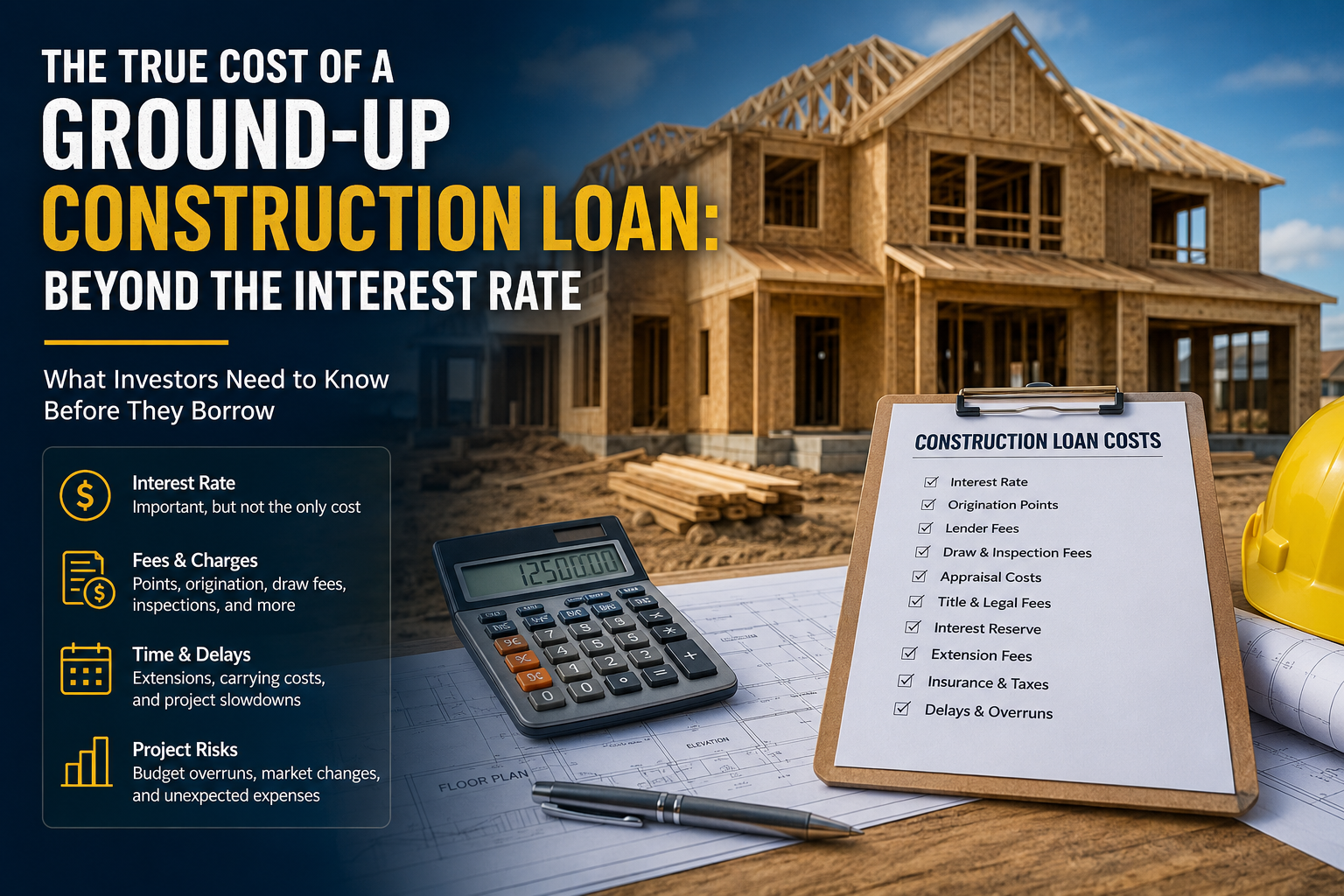
The actual cost of a ground up construction loan can include origination points, lender fees, appraisal costs, draw and inspection fees, interest reserves, title expenses, legal costs, extension fees, and the cost of delays.
For an investor, these expenses matter because they directly affect the profit on the project.
A difference of $25,000 in financing costs may not seem significant on a $2 million development. But if the project’s expected profit is $150,000, that $25,000 represents a meaningful portion of the return.
That is why experienced investors look beyond the advertised interest rate.
The better question is:
What will this loan actually cost me from closing until I pay it off?
What Is a Ground Up Construction Loan?
A ground up construction loan is financing used to build a new property from the beginning.
Depending on the lender and project, the financing may cover the purchase of land, construction costs, certain soft costs, and other eligible expenses.
The loan process is different from a traditional mortgage.
With an existing property, the lender can inspect the building and determine its current market value.
With a ground up project, there may be little or nothing built on the property yet.
The lender has to evaluate the proposed project.
That can include:
The land
Building plans
Construction budget
General contractor
Borrower experience
Projected completed value
Construction schedule
Borrower’s equity
Available liquidity
Exit strategy
The lender is essentially asking a simple question:
Does this project make sense, and can the borrower realistically complete it and repay the loan?
Construction financing is also usually funded in stages.
Instead of giving the borrower the entire loan amount on day one, the lender releases funds as construction progresses. These payments are commonly called draws.
The lender may inspect the property, review invoices or other documentation, confirm the work completed, and then release the next draw.
That process creates additional costs and administration that you do not normally see with a standard mortgage.
Why the Interest Rate Is Only Part of the Cost
Consider two hypothetical lenders.
Lender A offers a 9.5 percent interest rate.
Lender B offers a 10 percent interest rate.
Most borrowers would initially choose Lender A.
But now assume Lender A charges two points, has higher draw fees, requires more frequent inspections, and has a 12 month loan term.
Lender B charges one point, has lower draw costs, and gives the borrower 18 months to complete the project.
Suddenly, the comparison is not so obvious.
The lower rate does not automatically mean lower financing costs.
This is especially important for investors because construction projects can take longer than expected.
A permitting issue can delay the start.
A contractor can fall behind.
Material deliveries can take longer.
An unexpected site condition can increase the budget.
A change order can add weeks to the schedule.
If you need to extend the loan, the cost can increase again.
When comparing a ground up construction loan lender, you should therefore look at the complete loan structure rather than focusing on one number.
1. Interest Expense
Interest will usually be one of the largest costs associated with construction financing.
However, construction loan interest may work differently from the interest on a traditional mortgage.
Many construction loans use staged funding.
Suppose your lender approves a $1 million construction loan.
You may not borrow the entire $1 million on the first day.
If only $200,000 has been drawn, the interest calculation may initially be based on the amount outstanding.
As construction progresses, additional money is drawn.
The balance increases.
The interest expense increases with it.
This makes the construction schedule extremely important.
Imagine that you expect your project to take 12 months.
If everything stays on schedule, you may finish construction within the expected loan term.
But if the project takes 16 months, you could have four additional months of interest and other carrying costs.
Before signing a loan agreement, ask the lender how interest is calculated and when interest payments begin.
Do not make assumptions.
2. Origination Points
Points are another major cost to consider.
One point generally represents 1 percent of the loan amount.
On a $1 million loan:
One point equals $10,000.
Two points equal $20,000.
Three points equal $30,000.
That can make a significant difference to an investor.
For example, suppose one lender offers a 9.5 percent rate with two points.
Another offers a 10 percent rate with one point.
The first lender has the lower rate.
The second lender has the lower upfront cost.
Which one is cheaper?
It depends on how long you expect to hold the loan and what the other fees and terms look like.
This is why investors should calculate both upfront financing costs and expected interest expense.
3. Lender and Underwriting Fees
Depending on the lender and loan structure, you may also encounter fees for underwriting, processing, document preparation, construction administration, servicing, or other loan services.
Some lenders have a simple fee structure.
Others have several separate charges.
Neither approach is automatically better.
What matters is transparency.
When you receive a loan proposal, ask for a complete breakdown of the expected costs.
You should be able to understand:
What you are paying at closing
What you will pay during construction
What you will pay when draws are processed
What happens if you need an extension
What you will pay when the loan is paid off
A reputable ground up construction loan lender should be able to explain these costs clearly.
If you cannot understand the fee structure, that is a reason to slow down and ask more questions.
4. Appraisal and Valuation Costs
A lender needs to know what the property is expected to be worth when construction is complete.
That usually means the lender needs some form of appraisal or valuation analysis.
The valuation may consider the property location, plans, specifications, comparable properties, proposed improvements, and expected completed value.
The appraisal is important for more than just determining value.
It can also affect how much you can borrow.
Suppose you build a property for $1 million and expect it to be worth $1.5 million when completed.
If the appraisal supports your expected value, the financing structure may work as planned.
If the completed value comes in significantly lower, you may need to contribute more equity.
This is why investors should be realistic about projected values.
An optimistic valuation can make a project look attractive on paper while creating financing problems later.
5. Draw and Inspection Fees
Construction loans are usually funded through draws.
You complete a certain amount of work.
The lender verifies the progress.
The next portion of the loan is released.
The lender may require an inspection before releasing funds.
Depending on the lender, there can be fees associated with these inspections and draws.
The Consumer Financial Protection Bureau recognizes inspection and handling fees associated with staged construction loan disbursements as potential construction loan costs in applicable transactions.
A single inspection fee may not seem significant.
But consider a project with 10 or 12 draws.
Those costs can add up.
Investors should ask:
How many draws are expected?
How often can I request a draw?
How long does the lender usually take to process a draw?
What documentation is required?
Who performs the inspection?
What does each inspection cost?
Is there a reinspection fee?
These details can have a real impact on project cash flow.
6. Interest Reserves
An interest reserve is another feature investors may encounter with construction financing.
An interest reserve sets aside money to cover interest during the construction period.
This can be helpful because the investor may not need to make every interest payment from outside cash.
But an interest reserve should not be viewed as free money.
It is part of the financing structure and ultimately contributes to the project’s overall cost.
There is also a risk if construction takes longer than planned.
Suppose your lender estimates that the project will take 12 months and creates an interest reserve based on that timeline.
The project takes 16 months.
The reserve may not be sufficient to cover the additional interest.
You may then need to bring additional cash to the project.
For this reason, investors should stress test the interest reserve instead of assuming the original estimate will always be enough.
7. Title, Legal and Closing Costs
Ground up construction financing can also involve title and legal expenses.
Depending on the transaction, you may have costs associated with title insurance, title searches, recording, legal documents, and other closing requirements.
The exact costs vary by state, property, transaction, and lender.
These expenses are easy to overlook because they may not be included in the advertised loan rate.
But they still affect your total cost of capital.
If you are comparing several lenders, ask each one for an estimated closing cost breakdown.
Then compare the numbers side by side.
8. Loan Extension Fees
This is one of the costs that deserves extra attention.
Construction delays happen.
You may plan for a 12 month project, but the actual construction period may take longer.
Suppose you have a 12 month loan term.
At month 10, the property is not finished.
You now need another four or six months.
Depending on your loan agreement, you may need to request an extension.
That extension could involve an additional fee and continued interest.
The lender may also require updated project information, financial statements, or other documentation.
Some published construction loan programs disclose extension fees, although the amount and structure vary by lender.
This is why you should ask about extensions before closing.
Do not wait until your loan is about to mature.
Ask:
What happens if I need another six months?
You want to know the answer while you still have the ability to compare financing options.
9. Construction Cost Overruns
A construction budget is an estimate.
Even a well prepared budget can change.
Unexpected site conditions can appear.
Material costs can change.
The city may require additional work.
The investor may approve upgrades.
A subcontractor may submit a change order.
Suppose your original construction budget is $800,000.
The final cost is $900,000.
You now have a $100,000 gap.
Who pays it?
The answer depends on the loan agreement and lender.
In many situations, the borrower may need to contribute additional equity.
That is why experienced investors do not put every available dollar into the initial project.
Liquidity matters.
A profitable project can still become a problem if you run out of cash during construction.
10. The Cost of Delays
Time is money in construction.
A delay can increase more than your interest expense.
You may also have additional:
Insurance costs
Property taxes
Utilities
Security expenses
Construction management costs
Loan extension costs
Interest expenses
The delay can also affect your exit.
If you planned to sell the property after completion, a later completion date means a later sale.
If you planned to refinance and hold the property, your refinancing timeline changes too.
For ground up construction loan for investors, the construction timeline should therefore be treated as part of the financing strategy.
It is not just a contractor issue.
It is an investment issue.
A Realistic Example of Total Financing Cost
Let’s use a simple example.
Suppose an investor obtains a $1 million ground up construction loan.
Assume the loan has:
A 9.5 percent interest rate
Two origination points
$5,000 in appraisal and valuation expenses
$3,000 in draw and inspection expenses
$5,000 in other lender and closing expenses
The two points equal $20,000.
The other listed expenses equal $13,000.
That means the investor has $33,000 in financing related costs before calculating the actual interest expense.
Now imagine construction takes four months longer than expected.
The investor may have to pay additional interest and potentially other carrying costs.
If the loan also requires an extension, the total financing cost can increase again.
This is why comparing a 9.5 percent loan with a 10 percent loan without looking at the rest of the terms can lead to the wrong conclusion.
The example is simplified, and actual costs vary by lender, borrower, property, location, and loan structure.
But the principle applies to almost every construction project.
Look at the total cost, not just the rate.
How to Compare Ground Up Construction Loans
If you are an investor evaluating multiple financing options, build a simple comparison sheet.
For each lender, record:
Interest rate
Loan amount
Loan to cost ratio
Loan to value ratio
Origination points
Lender fees
Appraisal costs
Draw fees
Inspection fees
Interest reserve
Required equity
Liquidity requirements
Construction period
Loan maturity
Extension fees
Prepayment terms
Draw timing
Cost overrun requirements
Exit requirements
Once the numbers are next to each other, the differences become much easier to understand.
You may discover that the lender with the lowest rate is not the best fit for your project.
That does not mean the lender with the highest rate is better either.
The right loan depends on the project.
A small residential build has different financing needs from a multimillion dollar multifamily development.
A 10 month construction schedule has different requirements from an 18 month schedule.
An experienced investor may have different financing options from a first time developer.
The best loan is the one that fits the project and your financial position.
Questions to Ask a Ground Up Construction Loan Lender
Before you commit to financing, ask these questions.
What is the total cost of the loan?
Ask for a complete estimate instead of focusing only on the rate.
How are draws handled?
Find out what documentation is required, whether inspections are required, how quickly draws are processed, and what each draw costs.
How is interest calculated?
Ask whether you pay interest on the amount drawn or according to another method.
How much liquidity do I need after closing?
This is an important question for investors because you may need additional cash if the project runs over budget.
What happens if construction goes over budget?
Understand when the borrower must contribute additional equity.
What happens if construction is delayed?
Ask about extension fees, loan maturity, and the process for requesting additional time.
What is the expected exit strategy?
Tell the lender whether you plan to sell, refinance, or hold the property.
Your financing should support the strategy you actually intend to use.
What Should Investors Look for in a Construction Lender?
Choosing a lender is about more than price.
You also want a lender that understands construction.
A good lender should be able to explain the loan structure in straightforward language.
You should understand how draws work.
You should know what happens if the budget changes.
You should know what happens if construction takes longer.
And you should understand what the lender expects from you throughout the project.
Communication matters too.
Construction is unpredictable.
A project can look completely normal at closing and encounter a serious issue six months later.
When that happens, having a lender that communicates clearly can make the situation much easier to manage.
Frequently Asked Questions About Ground Up Construction Loans
What is the true cost of a ground up construction loan?
The true cost includes more than the interest rate. Investors should consider interest, origination points, lender fees, appraisal costs, draw and inspection fees, title and legal costs, interest reserves, extension fees, and other project related financing expenses.
Are ground up construction loans expensive?
They can be more expensive than traditional mortgages because construction financing involves additional risk, staged funding, inspections, project monitoring, and shorter loan terms. However, the cost varies significantly between lenders and projects.
Do ground up construction loans have closing costs?
Yes. Depending on the transaction, closing costs can include lender fees, appraisal costs, title expenses, recording charges, legal costs, and other expenses.
Do you pay interest on the entire construction loan?
Not necessarily. Many construction loans use staged draws, which means interest may be calculated based on the amount that has been advanced. The exact structure depends on the lender and loan agreement.
What is an interest reserve?
An interest reserve is money included in the financing structure to cover interest during construction. It can reduce the amount of outside cash the borrower needs for monthly interest payments, but it still contributes to the overall financing cost.
What are construction loan draw fees?
Draw fees are charges associated with releasing construction funds. A lender may require an inspection and documentation before releasing each draw.
What happens if construction costs exceed the loan budget?
Depending on the loan agreement, the borrower may need to contribute additional equity to cover the difference. Investors should maintain sufficient liquidity and include a reasonable contingency in the project budget.
What happens if construction takes longer than expected?
A delay can increase interest, insurance, property taxes, utilities, and other carrying costs. If the loan reaches maturity before construction is completed, the borrower may also need an extension.
How should investors compare ground up construction loan lenders?
Compare the entire financing structure. Look at interest rate, points, fees, draw costs, equity requirements, liquidity requirements, construction period, loan maturity, extension terms, and exit requirements.
Can land equity be used toward a ground up construction loan?
It can be possible, depending on the lender and loan structure. Some lenders may allow existing land equity to count toward the borrower’s equity contribution. Investors should ask the lender how land value is treated in the loan to cost calculation.
What is the biggest mistake investors make when choosing a construction loan?
One of the most common mistakes is focusing almost entirely on the interest rate. A lower rate does not necessarily mean a lower total financing cost. Investors should consider the complete loan structure and the potential cost of delays.
Is a ground up construction loan good for investors?
A ground up construction loan can be useful for investors who have a viable development project, sufficient equity and liquidity, a realistic construction budget, and a clear exit strategy. The financing should be evaluated alongside the project’s expected costs, value, timeline, and return.
Final Thoughts
A ground up construction loan is one of the most important parts of a development project’s financial structure.
That is why investors should not choose financing based on the interest rate alone.
Look at the full picture.
How much are you paying in points?
What are the lender fees?
How much will draws cost?
How is interest calculated?
How much liquidity will you need?
What happens if construction goes over budget?
What happens if the project takes six months longer?
What will an extension cost?
What is your exit strategy?
These questions can make a bigger difference to your investment return than a small change in the advertised interest rate.
For investors looking at ground up construction loans, the goal should be to find financing that fits the project from beginning to end.
A good ground up construction loan lender should give you a clear understanding of the costs, requirements, draw process, timeline, and potential risks.
And if you are specifically evaluating a ground up construction loan for investors, remember that the loan should be analyzed as part of the entire investment.
The property needs to make sense.
The construction budget needs to make sense.
The projected value needs to make sense.
The timeline needs to be realistic.
And the financing needs to support all of it.
The cheapest loan on paper is not always the cheapest loan in practice.
The better financing option is the one that gives your project a realistic path from land acquisition to construction, completion, and final payoff while keeping your total cost of capital under control.
That is the number that matters to an investor.
Leave a Reply